
DEATH DOULA SUPPORT
There is a stretch of time the medical system cannot reach. You do not have to be in it alone.
At a glance
You are inside a kind of time no one warned you about.
The diagnosis came. Or it came a while ago and the situation has changed. Or hospice has been called, or has not been called yet, or has been called and then sent home for the night. The doctors have said what they can say. Someone mentioned the words comfort care and then the appointment ended.
And now you are here, in what I have come to call the weird block of time: the suspended weeks or months between a terminal diagnosis and active dying, when the medical system has effectively gone home and the spiritual world has not yet shown up. The person you love is still here, and also already leaving. Nothing is the right size.
The family is starting to fracture, quietly or loudly. Someone is in denial. Someone is over-functioning. Someone is missing. Old grievances are surfacing because the room is finally honest enough to hold them. The bickering at the bedside is not because anyone is bad. It is because no one knows what to do.
The dying person is trying to hold it together for everyone else. They cannot say the thing they most need to say, because every time they open their mouth someone rushes to reassure them out of it. “Don’t talk like that.” “You’re going to be fine.” “Let’s not go there.” The truth has nowhere to land.
And you, whoever you are in this constellation, are trying to be enough, without knowing what enough looks like.
What if being there is the whole job?
Almost everyone in this situation is looking for the right thing to do. The right words, the right question, the right way to be at a bedside. And the not-knowing feels like failure, on top of everything else you are already carrying.
There is nothing you are supposed to be doing. Presence is not a lesser version of helping. In these rooms it is the thing itself, and most people only find that out afterward.
Families tell me later that this stretch, the one they were bracing through and trying to survive, became one of the most important of their lives. Not because it stopped being hard. Because something true was finally allowed to happen in it: a last conversation, an apology held for decades, a long silence in which everyone was simply present. Sometimes a laugh, which surprises people and takes nothing away from any of it.
I have been in these rooms for 14 years.
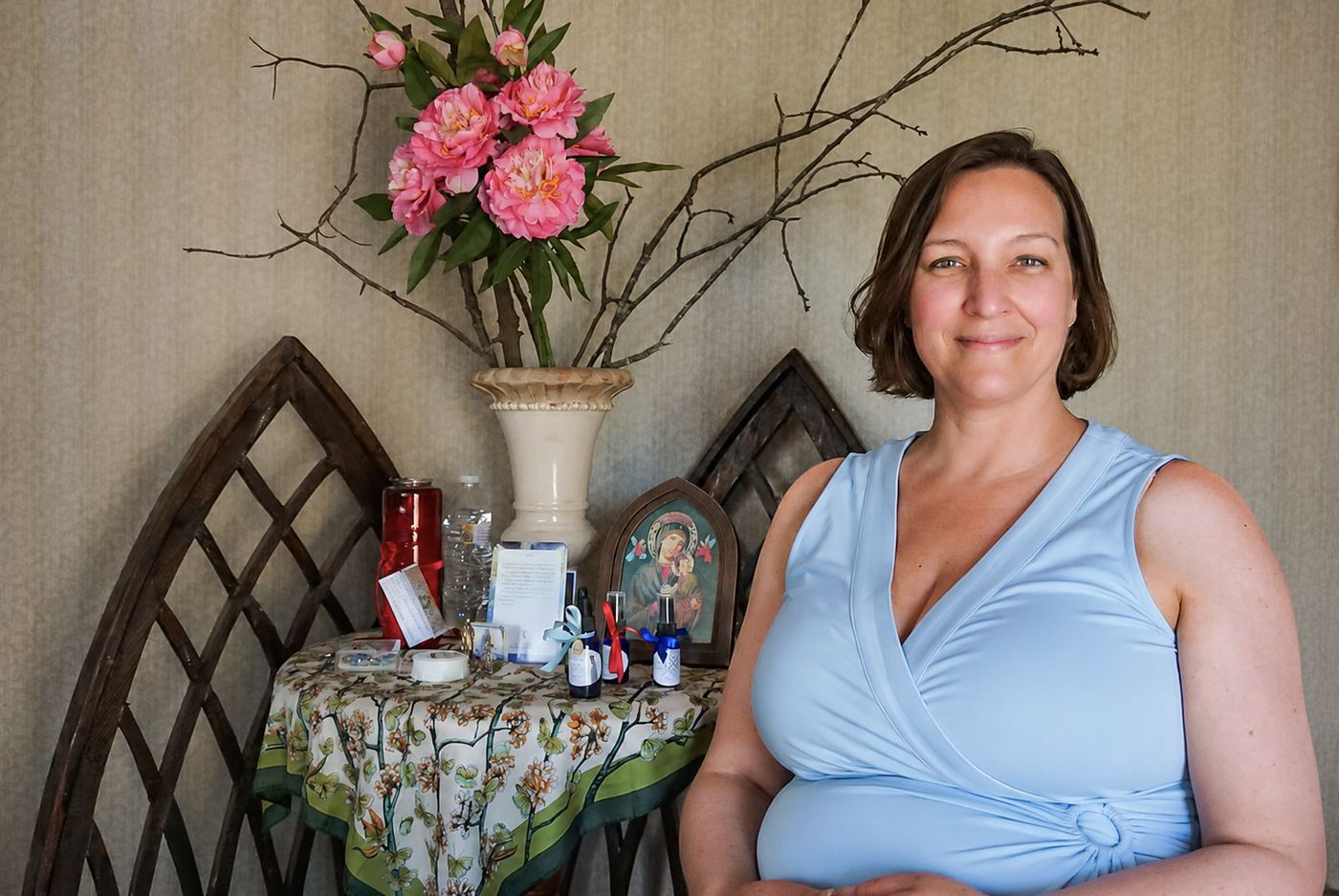
I’m Katie Quinn. IAPCC Certified Death Doula, medium, Reiki Master, IET Master. Before this work I ran my own CFO and accounting practice, so I understand the capable, logistical world families like yours live inside, and I know what it is to want a plan and a list and a thing to do.
I have sat with the dying themselves and with the families around them. With the spouse who has not left the bedside in three days. With the adult daughter who flew across the country and does not know what she came to do. With the family that had not been in the same room in twenty years and now cannot leave one. With the dying person who finally, in the quiet hour after everyone went home, said the sentence they had been holding for months.
I arrive with nothing you have to learn. No rituals to adopt, no beliefs to take on, no instruction about what anyone should be feeling or how this should be approached. There is no right way. There is only what is true in this room, on this day, for these people.
What I bring is presence. Reiki, when it serves. The lived experience of having sat in many of these rooms and seen what tends to help. And, when the dying person wants it, a space where they can say “I am dying” out loud without having to manage anyone else’s feelings about it. Almost no one in their life can hold that sentence. I can.
Two streams, usually braided together.
For the dying person.
When they want me to, I work with them directly. Sometimes long conversations. Sometimes silence. Sometimes Reiki, to ease what the body is carrying. Sometimes being the person they can finally say it to.
“I am dying.” Said out loud, to someone who can hear it without flinching, is one of the most important things a person can do at the end of a life, and one of the rarest. Family members, however loving, are almost always too close. They argue with it, soften it, redirect it. The dying person learns fast that the sentence costs the people they love more than they can bear to charge.
I am not in that constellation. I can hear it. I can let it sit in the room. That is often the most important work of the whole engagement.
For the family.
Sometimes that means sitting at the bedside, helping you learn what presence feels like when it is not also performing. Sometimes meeting away from the dying person, so you have somewhere to bring what you cannot bring into the room. Sometimes helping you find words for a conversation you have been afraid to have. Sometimes just being the steady person in the house, the one whose presence reminds everyone else that they can exhale.
I do not direct the family and I do not tell anyone how to grieve in advance. I help you find what is already true, and I help the room hold it.
How engagements are structured.
There is no template. Some families work with me intensively in the final weeks. Some bring me in around the time of diagnosis and we work in a slower rhythm over months. Some call me only at the bedside. Some keep working with me in the weeks after, when the medical system is gone and the grief is beginning to arrive in its real form.
We figure out the right shape together, in the first conversation. That is why every engagement begins there.
This work is for you if
- Someone you love has a terminal diagnosis and you are inside the strange stretch between that and what comes next. You do not know what would help. You are looking for someone who has been here before.
- You are the dying person, and you want someone to talk to who is not your family, not your doctor, and not asking you to be brave for them. You want a witness, not a manager.
- You are the family member trying to hold something together, exhausted in a way that has nothing to do with sleep. You need someone steady in the room so you can finally be inside your own experience of this.
- Your family is fracturing, and you can feel that the bickering is about something deeper than what is being argued about.
- You are in the period after a death. The funeral is over, everyone has gone home, and the grief is just now arriving in its real form.
And it is probably not for you if
- The dying person is a child. I do not work with dying children. That work belongs to specialists trained for it, who have built their practices around it and will serve your family far better than I could. Look for a pediatric palliative care doula or a hospice with a pediatric specialty. If you reach out, I will gladly help you find a referral.
- You need medical care. This work is non-medical. No nursing, no medication management, no clinical intervention. I work alongside hospice and palliative care, never in place of them. If the medical side is what you need, hospice is the right first call, and I am happy to work with your family once they are in place.
- You are looking for someone to make decisions. I am a presence, not a decision-maker. I will help the family find clarity, but the decisions belong to you and the dying person.
- You would rather skip the first conversation. I understand the impulse, particularly when time feels short. The work is too important to walk into cold, and that conversation is usually quick.
How to begin.
Reach out.
We talk.
We begin.
A note on fees
What changes when the work is in place.
The dying person gets to say it. Out loud, to someone who can hear it. They get to talk about their own death, their own fears, their own hopes for what comes next, without holding the rest of the room together while they do. Many, having said it, arrive at a kind of peace that families later describe as the gift of the whole arc.
The family stops trying so hard. They learn, often for the first time, that being present is enough. The bedside softens. The performance falls away. The exhausted over-functioning eases, because someone else is in the room holding what no one in the family could hold.
The bickering loses its grip, not because everyone suddenly agrees, but because the charge underneath it, the fear and the helplessness, finally has somewhere to go. And the denial loosens, not into despair but into honest grief that can move through a person rather than getting stuck. Families who let it loosen during the dying tend to come through bereavement in considerably better shape.
The room becomes a place where something true can happen. Families remember those moments for the rest of their lives. Looking back, they are often the moments that redeem an otherwise unbearable stretch of time.
In the period after, you have someone to come back to. The grief that arrives once the funeral is over and everyone has gone home is real, and it is the part nobody tells you to prepare for. Many families continue with me through it, sometimes for a season, while the new shape of life finds itself.
Tracy Lunt
The questions families ask first.
How quickly can you start?
As quickly as the situation requires. If you write and the situation is time-sensitive, say so, and I will get to you as fast as I can. You can also call 781-405-4086.
Do you work alongside hospice?
Yes, always. This work is non-medical and sits beside the clinical team rather than in place of it.
Can you work with the dying person if the family is not on board, or the other way around?
Often, yes. We would talk it through in the first conversation. These situations are common and they are workable.
What happens after the death?
Many families continue with me for a period afterward. That support is available whether or not I was involved before.
What if we are not sure we need this?
Then the conversation is the right place to find out. It costs nothing and commits you to nothing.
An add-on: when a family has to leave a home.
The four services are entry points into the same body of work.
- →Services Overview to see all four side by side.
- →Mediumship if someone has already died and you want to connect with them.
- →Group Events if you would like to see the work in a room first.
- →Truth Readings if what you are carrying is a question about your own direction.
Whenever you are ready
There is no wrong moment to reach out. Some families contact me around the time of diagnosis. Some in the last week. Some in the month after the funeral. All of those are real starting points, and none of them is too early or too late.
If today is the day, write. If you are not sure yet, schedule a first conversation.